Identify before ordering
Model, serial or product identification, year or production range, shaft and gearcase details, and the installed parts determine the correct schedule, fluids, filters, spark plugs, seals, and procedures.
 IRONWAKECUSTOMS(202) 600-6906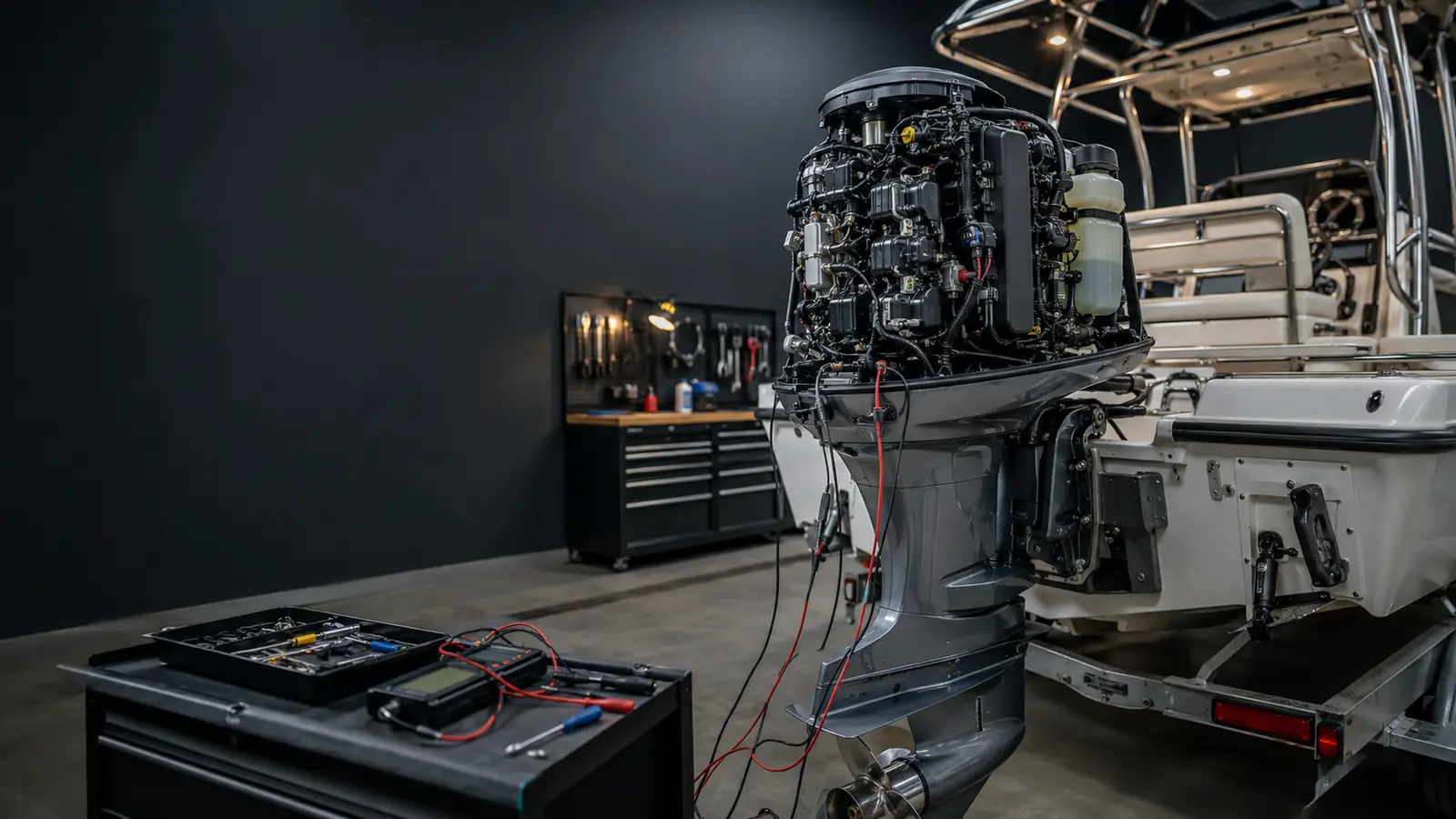
Outboard maintenance · Colonial Beach region
Maintain the exact engine in front of you—not a generic tune-up checklist.
The search that brought you here
For boat owners searching for outboard motor maintenance, outboard service, a marine engine tune-up, or scheduled outboard care near Colonial Beach, Dahlgren, King George, the Northern Neck, and genuinely served nearby Southern Maryland.
Two outboards with the same hours may need different work because one is a four-stroke and the other a two-stroke, one has a complete record and the other has unknown history, or one has seen brackish shallows, long storage, debris, and repeated short trips. Ironwake builds the maintenance scope from the engine identification and manufacturer schedule, then checks the condition of accessible fluids, filters, fuel delivery, ignition parts, cooling components, electrical connections, corrosion protection, propeller and gearcase, controls, and trim system. Active alarms, contaminated lubricant, low compression, overheating, fuel leakage, wiring damage, collision evidence, or poor running are separated into diagnostic or repair work instead of being hidden inside the word tune-up.
Tell us about the vehicle, truck, or boat →Model, serial or product identification, year or production range, shaft and gearcase details, and the installed parts determine the correct schedule, fluids, filters, spark plugs, seals, and procedures.
Calendar age, engine hours, operating pattern, water conditions, storage, prior overheating, debris strikes, and service documentation are considered together. Low hours do not erase age or unknown history.
Routine maintenance is not a promise that an engine is healthy. Abnormal fluid, faults, leakage, corrosion, compression, temperature, charging, or run quality becomes a documented decision instead of an unapproved parts swap.
What the project may include
The exact scope follows the engine manufacturer's current information, engine type, service interval, equipment access, parts support, warranty considerations, prior work, current condition, and approved estimate. The list below describes planning categories, not a package automatically performed on every engine.
A deliberate service sequence
The sequence starts with identity and evidence, then defines the scheduled work, inspects for conditions that change the scope, completes only approved service, and records the result. A manufacturer's manual and current service information take precedence over a generic interval copied from another engine.
Record the manufacturer, model, serial or product identification number, production information, horsepower, shaft length, gearcase, rigging, controls, gauges, and boat application. Confirm whether the engine is a two-stroke, direct-injected two-stroke, or four-stroke and locate the correct owner's manual, maintenance chart, fluid specifications, part references, service bulletins, and applicable warranty requirements. Similar cowling graphics do not prove two engines use the same plug, filter, lubricant, interval, torque, or procedure.
Document total hours when available, hours since each known service, calendar age, salt, brackish, fresh, shallow, silty, or weedy operation, typical rpm and load, trolling time, flushing practice, fuel age, storage length, winterization, battery history, grounding or propeller strikes, overheating, alarms, prior repairs, and long periods without use. Receipts, logbook entries, date-marked filters, scan history, and owner notes are more useful than guessing from appearance. Unknown history is treated as unknown, not automatically labeled neglected or fully serviced.
Inspect for fuel odor or leakage, damaged wiring, overheated connections, oil or gear-lube loss, loose mounting hardware, corrosion, cracked hoses, blocked air or cooling inlets, propeller damage, fishing line at the shaft, trim leakage, warning lights, abnormal sound, smoke, vibration, starting difficulty, rough idle, weak charging, poor telltale flow, and stored faults where supported. Do not run an outboard without the model-appropriate water supply, run through an active overheat warning, shift an unsecured engine into gear, or treat a flush fitting as an engine-running supply unless the manufacturer explicitly permits it.
Map each due item to the exact schedule and evidence. Four-stroke engine oil does not apply to a conventional two-stroke in the same way; gearcase lubricant, fuel filtration, spark plugs, water-pump components, thermostats, belts, anodes, lubrication points, valve clearance, timing components, and other tasks have model-specific intervals and procedures. A water pump may need scheduled service, earlier inspection after dry running or debris, or diagnosis when temperature changes. Parts are not replaced merely because a generic tune-up list includes them.
Use the specified fluids, filters, plugs, seals, gaskets, lubricants, fasteners, quantities, gaps, torques, orientations, and disposal practices supported for the engine. Keep removed-fluid and component observations connected to their systems: milky gear lubricant, excessive metal, damaged plug threads, unusual plug condition, brittle impeller material, contaminated fuel, corrosion under a connection, or a failing belt can change the repair plan. Ironwake pauses for approval when evidence supports work outside the maintenance estimate.
After reassembly, check for fluid and fuel leaks, stable battery and cable behavior, control and safety-interlock operation, cooling flow, warning indications, temperature behavior, idle and supported running quality, charging data, trim operation, fastener security, and gear engagement only under safe, manufacturer-approved conditions. A brief driveway start cannot reproduce every on-water load, mounting, ventilation, fuel, cooling, or trim condition. Any limitation in the validation method is documented rather than turned into a performance guarantee.
Record the date, engine hours, identification, work completed, fluid and part specifications, observations, warnings or codes, measurements, unresolved findings, next interval, and any follow-up repair or on-water check. Keep receipts and the log with the boat so the next owner or technician can distinguish completed maintenance from assumed maintenance. Before future trips, continue the owner's pre-use checks and review current recall or safety information for the boat and installed equipment.
Local, appointment-based project work
Ironwake Customs is based in King George County and evaluates supported outboard maintenance on trailered boats for owners from Colonial Beach, Dahlgren, Fredericksburg, Stafford, Spotsylvania, the Northern Neck, and genuinely served nearby Southern Maryland by appointment. Potomac and brackish-water use can add silt, grass, salt deposits, corrosion, fuel-storage questions, seasonal layup, and cooling-system history to the maintenance plan. Send the boat and engine make, model, serial or PID, hours, last known service, owner's manual or schedule if available, water and storage pattern, fuel age, alarms or symptoms, photos of the engine and rigging, parts already purchased, and any deadline tied to launch or storage. An inspection may be needed before a complete estimate can be defined.
Check project fit ↗Useful planning references
These public, manufacturer, and industry resources add useful context for identification, system support, safety, and compliance. The exact vehicle and approved project scope still control the repair plan.
Yamaha directs owners to the exact engine schedule and explains general water-pump, belt, hose, spark-plug, thermostat, and air-intake maintenance considerations. Brand-specific examples are planning context, not a universal schedule for another engine.
Open source ↗Yamaha OutboardsThe manufacturer explains maintenance-record tracking, the importance of the owner's manual schedule, safe water supply for permitted out-of-water running, marine oil requirements, and warranty considerations for Yamaha engines.
Open source ↗U.S. Coast Guard Boating Safety DivisionThe Coast Guard provides access to documented and alleged defects, recall information, safety circulars, and defect reporting for recreational boats and associated equipment. Engine maintenance does not replace a recall or safety-defect review.
Open source ↗Questions owners ask before starting
Use the maintenance chart for the exact engine and track both operating hours and calendar time. Water conditions, storage, commercial or heavy use, debris, dry running, overheating, impact, fuel age, and unknown history can justify earlier inspection. A general annual or 100-hour phrase is not a substitute for the model-specific schedule.
Depending on the engine and interval, maintenance may include specified fluids and filters, gearcase service, fuel filtration, spark plugs, lubrication points, cooling-system items, belts or hoses, anodes, propeller and shaft checks, battery and electrical inspection, control checks, and a service record. Inspection determines which items apply and whether a separate repair is needed.
Not necessarily. Tune-up is an imprecise term that often means plugs and basic service, while the manufacturer schedule can include time- and hour-based work across lubrication, fuel, cooling, electrical, corrosion, control, and gearcase systems. Define the requested outcome and exact engine before comparing estimates.
No. Four-stroke outboards use crankcase oil and a specified service procedure, while two-stroke designs lubricate differently and may use an oil-injection or premix system. Both can still have gearcase lubricant and other scheduled items. Identify the exact engine before buying oil or filters.
Follow the exact manufacturer's interval and inspection criteria. Yamaha offers annual inspection as general guidance while still directing owners to the specific manual. Age, long storage, dirty or brackish water, debris, dry running, weak flow, overheating, and unknown history may change the decision. The housing, seals, water tube, thermostats, passages, and operating setup may also need evaluation.
A supported engine can be inspected, but missing history cannot be recreated with certainty. The starting scope uses identification, hours when available, fluid and component condition, faults, owner observations, and manufacturer information. Evidence of internal damage, unsupported parts, major corrosion, fuel contamination, or broader boat-system concerns may require a separate decision before routine service continues.
Send the boat and engine make, model, year or production information, serial or PID, horsepower, engine hours, photos of labels and rigging, last known service with receipts if available, water and storage pattern, fuel age, alarms or symptoms, recent overheating or impact, manuals, parts already purchased, trailer condition, and the work you believe is due. Inspection may still be needed before pricing.
The project needs a real starting point
Ironwake will review the vehicle, current condition, intended use, and requested scope before recommending the right next step.
Start the conversation ↗