Identify before connecting
Confirm the engine generation, reluctor pattern, crank and cam sensors, throttle type, injector data, controller, transmission, pedal, and harness part number before power is applied.
 IRONWAKECUSTOMS(202) 600-6906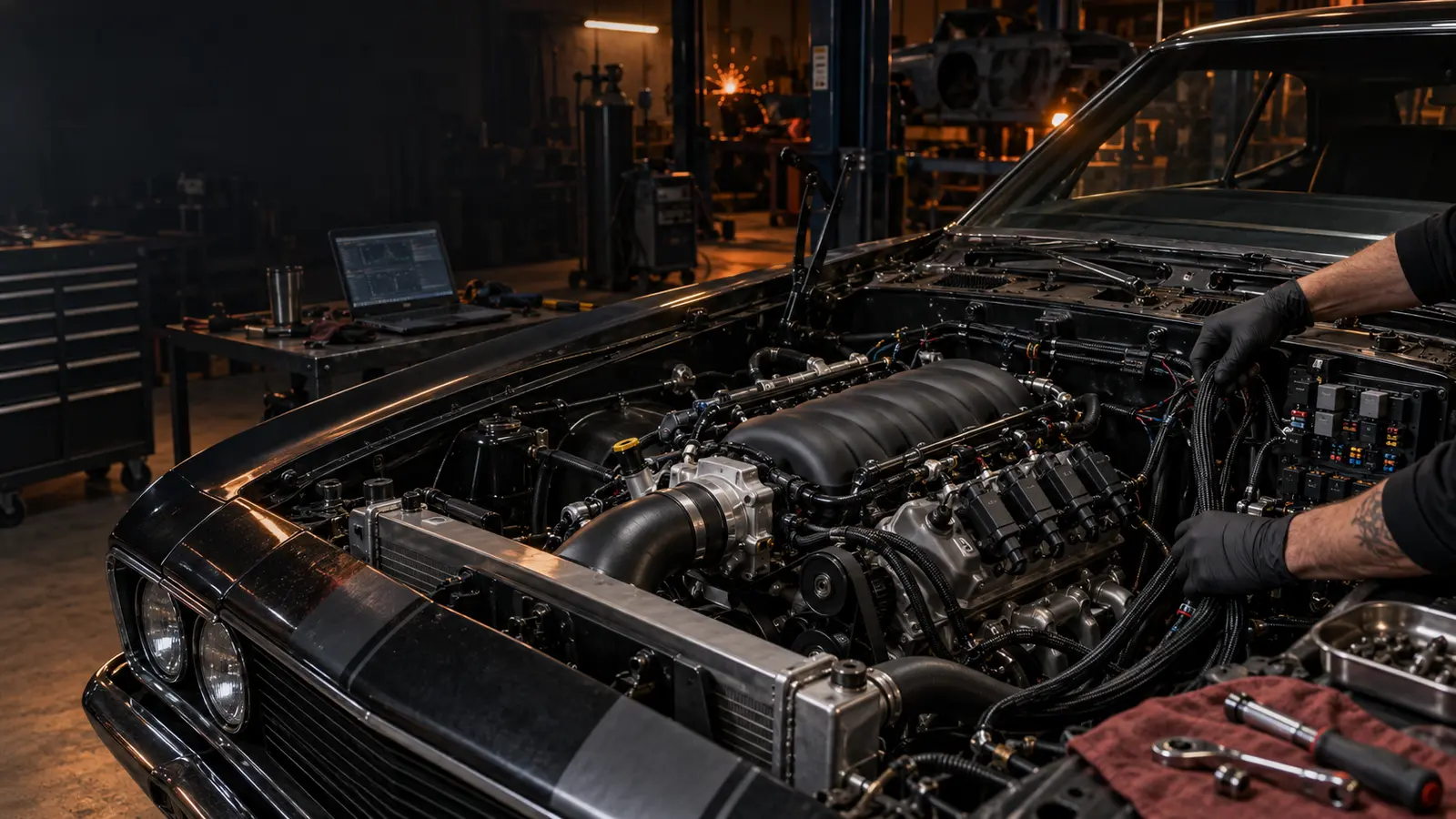
Classic LS electrical integration · Virginia
Build the electrical system so the swap starts, communicates, and remains serviceable.
The search that brought you here
For owners searching for LS swap wiring harness installation in Virginia, standalone LS harness wiring, ECU integration, or help finishing the electrical side of a classic-car or classic-truck LS conversion.
A harness is not finished when the injector and coil connectors click into place. The engine controller still needs clean power, protected circuits, dependable grounds, a fuel-pump strategy, cooling-fan control, a diagnostic port, gauge signals, starter and charging connections, and—depending on the combination—electronic throttle and transmission communication. Ironwake evaluates those interfaces together so the wiring supports the exact classic vehicle, engine, controller, transmission, accessories, and intended use.
Tell us about the vehicle, truck, or boat →Confirm the engine generation, reluctor pattern, crank and cam sensors, throttle type, injector data, controller, transmission, pedal, and harness part number before power is applied.
Plan battery feeds, ignition-switched power, relays, fuses, grounds, charging, starter control, and circuit protection around measured loads and the vehicle's existing electrical condition.
Mount the controller, fuse and relay center, connectors, and OBD-II port where they remain protected, labeled, inspectable, and reachable after the interior and engine bay are complete.
What the project may include
Project fit depends on the exact engine and controller, harness type and condition, transmission, throttle system, vehicle wiring, accessories, calibration status, emissions obligations, prior work, and parts support. Customer-supplied components are identified and checked before they are treated as compatible.
A deliberate service sequence
A useful project review starts with component identity and an honest electrical inventory. The exact sequence changes with the vehicle and control system, but these checkpoints reduce avoidable rework and make first power-up more deliberate.
Record casting, controller and service numbers; engine generation; crank and cam sensor configuration; throttle body and pedal; injectors; transmission; mass-airflow or speed-density strategy; harness brand and part number; and any existing calibration information. Similar-looking LS components are not automatically interchangeable.
Inspect the battery location, cables, grounds, charging path, ignition switch, starter circuit, bulkhead connector, fuse protection, existing gauges, aftermarket additions, and evidence of overheated, spliced, corroded, or undersized wiring. The new harness cannot make a weak chassis electrical system dependable by itself.
List every circuit that crosses between the LS controller and the car: key power, crank request, fuel-pump command, fan outputs, brake input, vehicle speed, tachometer, temperature, oil-pressure strategy, malfunction indicator, air-conditioning request, transmission signals, and diagnostic communication.
Plan the ECU, fuse and relay center, OBD-II port, bulkhead passage, grounds, and disconnects away from exhaust heat, sharp edges, water paths, moving linkages, and unnecessary engine-bay clutter. Allow connector access and enough service loop for future testing without creating loose wire bundles.
Support the harness at sensible intervals, use abrasion and heat protection where the environment requires it, seal pass-throughs, avoid tension at connectors, and keep power wiring separated from sensitive signal paths when appropriate. Document circuit identity instead of leaving the next diagnostic step to wire-color memory.
Check continuity, resistance where appropriate, power and ground paths, fuse values, relay control, polarity, connector seating, unused-circuit treatment, and the relationship between the controller and vehicle. Initial key-on checks should happen before fuel or starter operation is assumed safe.
Confirm scan-tool communication, sensor plausibility, throttle and pedal agreement when applicable, fuel-pump and fan commands, charging behavior, gauge operation, transmission data, stored faults, and calibration compatibility. Hardware or wiring faults should be corrected rather than hidden with calibration changes.
Local, appointment-based project work
Ironwake Customs is based in King George County and evaluates LS-powered classic-car and classic-truck projects from Fredericksburg, Stafford, Spotsylvania, Dahlgren, Colonial Beach, the Northern Neck, and nearby Southern Maryland by appointment. For an initial review, send the vehicle year, make and model; engine, ECU and transmission identifiers; harness brand and part number; throttle and pedal details; photos of the engine bay, fuse panel and current wiring; parts already installed; whether the engine has run in this vehicle; diagnostic codes; and a clear description of what remains unfinished.
Check project fit ↗Useful planning references
These public, manufacturer, and industry resources add useful context for identification, system support, safety, and compliance. The exact vehicle and approved project scope still control the repair plan.
A manufacturer-maintained reference for checking controller and calibration support before assuming a diagnostic or tuning path is available.
Open source ↗Chevrolet PerformanceManufacturer context for matched engine, controller and transmission packages and the components that must work together in a powertrain installation.
Open source ↗U.S. Environmental Protection AgencyFederal compliance context to review before changing emissions-related hardware, controls or calibration on a regulated vehicle or engine.
Open source ↗Questions owners ask before starting
Sometimes. The donor harness must match the engine sensors, controller, throttle system, injectors, transmission and intended functions, and it must be inspected for damage, missing circuits, prior splices and connector condition. Reworking an OEM harness and using a purpose-built standalone harness are different project paths.
The controller and its loads need correctly sized circuit protection and switching. Some standalone harnesses include a dedicated fuse and relay center; an OEM-based system may require a carefully planned equivalent. The final layout depends on the harness, fan and fuel-pump loads, accessories, and chassis wiring.
They may work through compatible senders, adapters, signal conditioning, a data interface, or separate engine and gauge sensors. Tachometer, coolant temperature, oil pressure, speedometer and warning indicators should each be mapped instead of assuming one solution fits every vehicle.
Supported electronic-throttle combinations can be evaluated. The pedal, throttle body, engine controller, operating system, harness and calibration must be compatible, and pedal mounting must preserve safe travel, clearance and driver ergonomics.
The controller must have a calibration appropriate to the engine, injectors, airflow hardware, throttle type, transmission and vehicle configuration. Security functions, fan settings, gear and tire information, and emissions-related requirements may also affect the plan. Calibration should not be used to cover a wiring or mechanical fault.
Possibly. Existing harness modifications, splices, power distribution, grounds, controller identity, component compatibility, calibration status and supporting systems must be documented before a responsible completion scope can be set.
Send the classic vehicle year, make and model; engine, ECU and transmission identifiers; harness manufacturer and part number; throttle and pedal information; clear wiring and engine-bay photos; a parts list; current symptoms or codes; and whether the engine has run in the vehicle. Inspection may still be required before pricing.
The project needs a real starting point
Ironwake will review the vehicle, current condition, intended use, and requested scope before recommending the right next step.
Start the conversation ↗