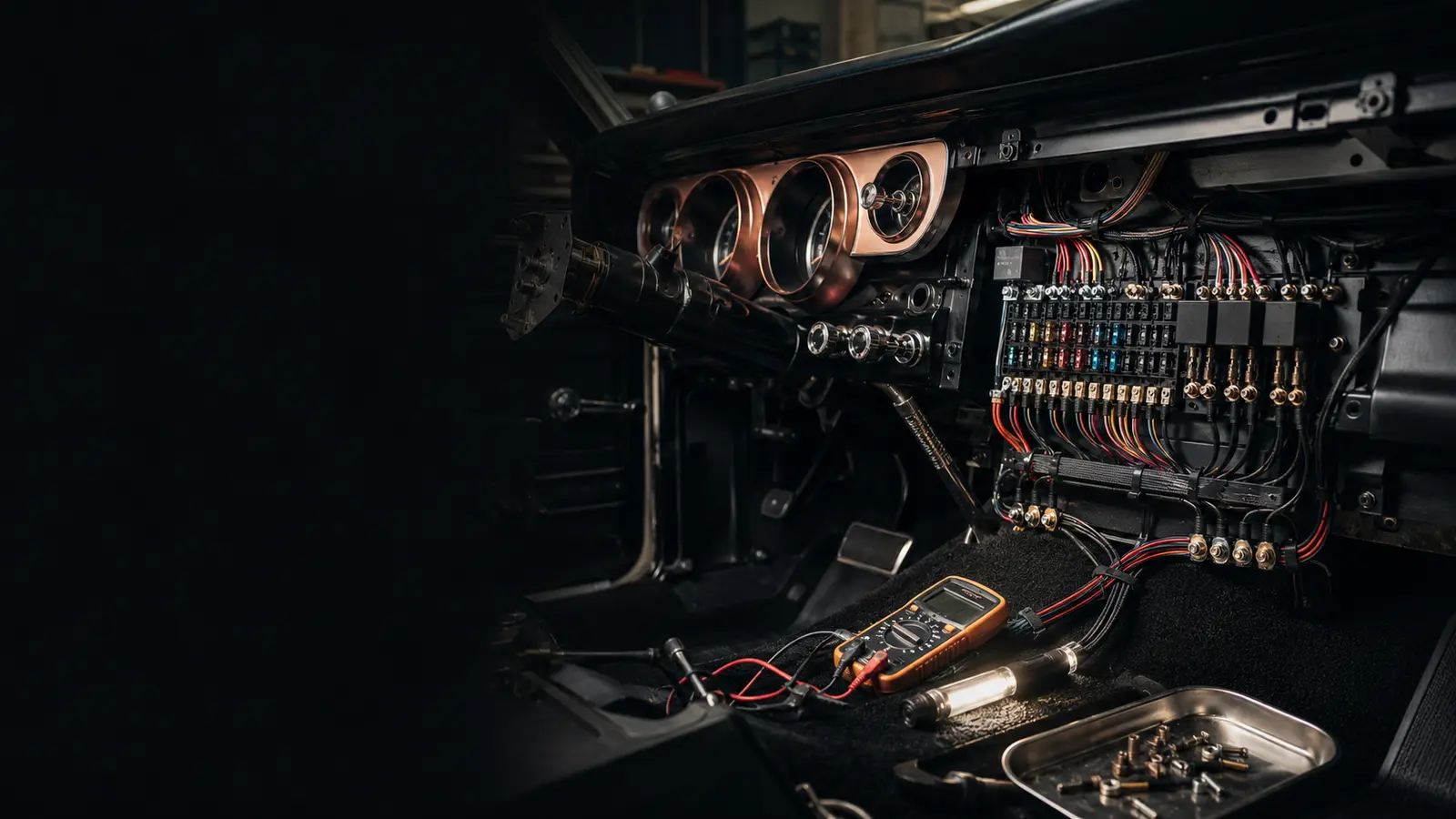
Classic car distributor, ignition coil, labeled wiring, and multimeter prepared for an electronic ignition conversion near Fredericksburg Virginia

Electronic ignition conversion · Fredericksburg region

Classic Car Electronic Ignition Conversion Near Fredericksburg, VA

Replace points-era uncertainty with a compatible, documented ignition plan.

The search that brought you here

An electronic trigger is only one part of a complete ignition system.

For owners searching for classic car electronic ignition conversion, electronic ignition for a classic car, points-to-electronic ignition, distributor upgrades, or ignition-system help near Fredericksburg, Stafford, Spotsylvania, and King George.

A points-replacement module, ready-to-run distributor, external ignition control, coil, ballast or resistance wire, spark-plug leads, tachometer, starter-bypass circuit, charging system, and engine timing all have to agree. A conversion selected only by engine family can create weak spark, overheated components, a damaged module, an inaccurate tachometer, hard starting, or an advance curve that does not fit the engine. Ironwake identifies the existing distributor and electrical architecture, tests the current system, and plans a supported conversion around the exact vehicle and intended use before changing parts.

Tell us about the vehicle, truck, or boat →
IRONWAKE STANDARD

Identify before ordering

Distributor casting and tag information, engine family, voltage, ground polarity, coil resistance, existing ballast strategy, wiring, tachometer, and manufacturer application data determine whether a module or complete distributor belongs in the project.

IRONWAKE STANDARD

Prove the supporting circuits

Cranking voltage, ignition-switch feeds, starter bypass, charging output, grounds, primary wiring, coil condition, plug wires, plugs, and mechanical advance are checked so a conversion does not conceal another fault.

IRONWAKE STANDARD

Set timing for the engine

Base timing, centrifugal advance, vacuum advance, total timing, compression, fuel, temperature, load, starter behavior, and detonation risk are treated as one calibration problem—not a universal number copied from another build.

What the project may include

Electronic ignition projects Ironwake can evaluate

Project fit depends on the engine and distributor, supported applications, system voltage and polarity, existing wiring, coil and ballast requirements, tachometer compatibility, emissions equipment where applicable, prior modifications, component condition, parts support, and whether the current symptom is actually caused by the ignition trigger.

A deliberate service sequence

A seven-stage path from points-era hardware to a verified ignition system

The sequence protects useful evidence, avoids mixing incompatible parts, and gives the finished system a serviceable baseline. The exact tests and specifications come from the vehicle, engine, distributor, and component manufacturers—not from a generic conversion recipe.

  1. 01

    Identify the engine, distributor, voltage, and ground polarity

    Record the year, make, model, engine family, firing order, compression and major modifications, then identify the distributor by casting, tag, shaft, cap, trigger, and drive details rather than appearance alone. Confirm whether the vehicle is six or twelve volts and positive or negative ground, and document any generator-to-alternator, starter, harness, or ignition-switch changes. A conversion kit may fit one distributor family but not another that shares the same engine. Application data, component instructions, and physical inspection must agree before parts are approved.

  2. 02

    Preserve the symptom and establish a measured baseline

    Before removing points or a suspected distributor, document cold and hot starting, crank speed, supply voltage during crank and run, dwell where applicable, coil primary resistance by the correct procedure, spark-plug condition, cap and rotor wear, plug-wire routing, timing at idle, advance with engine speed, vacuum-advance response, and any misfire, ping, backfire, stall, or tachometer fault. If the engine already runs well, this baseline helps preserve what works. If it does not, it prevents an electronic module from being asked to fix fuel, compression, grounding, charging, or mechanical-distributor problems.

  3. 03

    Choose a conversion architecture that the application supports

    Decide whether the project should retain the original distributor with an internal electronic trigger, use a supported ready-to-run distributor, or add an external ignition control. The choice depends on distributor condition, parts support, appearance goals, service access, rpm range, tachometer and accessory needs, desired advance control, engine configuration, and manufacturer application guidance. A hidden module may preserve a stock appearance, while a full distributor can replace worn mechanical parts, but neither choice is automatically correct. Original parts can be labeled and retained when reversibility is part of the approved scope.

  4. 04

    Match the coil, resistance, power feed, and protection

    Verify the module or ignition control's required voltage, ground, coil primary resistance, ballast resistor or resistance-wire strategy, current limits, fuse or circuit protection, polarity, and cranking bypass arrangement. Some systems require full battery voltage, some use a specified resistor, and some control the coil through a separate box; those instructions cannot be combined casually. Test voltage at the component during cranking and hot idle, inspect terminals and grounds under load, and route wiring away from exhaust, sharp edges, moving linkage, and high-voltage leads. Any charging-system fault is addressed before it can over- or undervoltage new electronics.

  5. 05

    Install with service access, correct phasing, and clean wiring

    Mark rotor position, firing order, plug-wire locations, housing orientation, and the original timing reference before disassembly. Follow the exact air-gap, magnet sleeve, pickup, rotor, gear, clamp, connector, wire-routing, and grounding instructions for the approved hardware. If a complete distributor is installed, account for helical gear rotation and oil-pump drive engagement rather than forcing the housing. Keep primary and trigger wiring separated from noise sources where instructed, provide strain relief, protect pass-throughs, and label any added connector. No unknown wire is used as a power source until its key-on, crank, run, and shutdown behavior is measured.

  6. 06

    Set base timing and verify the entire advance curve

    Start from a conservative, supported setting and confirm the timing mark and reference are trustworthy. Measure base timing, the beginning and rate of centrifugal advance, total mechanical advance, vacuum advance, idle speed, manifold vacuum, cranking behavior, and hot restart response. Compression, combustion chamber, fuel octane, mixture, temperature, load, gearing, vehicle weight, and intended use can change what the engine tolerates. Stop for detonation, starter kickback, overheating, unstable timing, or any fuel or electrical hazard. The goal is a documented curve that suits the engine and instructions, not the largest advance number the engine will briefly accept.

  7. 07

    Validate cold, hot, loaded, and fail-safe behavior

    After the approved work, repeat cold starts, heat soak and hot restarts, idle, controlled acceleration, steady cruise, and deceleration checks appropriate to the vehicle. Confirm stable cranking and running voltage, clean shutdown, tachometer behavior, timing stability, advance return, plug-wire clearance, connector security, and the absence of arcing, leakage, abnormal heat, detonation, or new radio-frequency interference. Reinspect terminals and the distributor hold-down after the initial heat cycles. Document the installed part numbers, wiring, timing settings, retained original parts, manufacturer instructions, maintenance notes, and any engine, fuel, charging, or drivability concern that remains outside the ignition conversion.

Local, appointment-based project work

Electronic ignition conversion for Fredericksburg-area classics

Ironwake Customs is based in King George County and evaluates supported electronic ignition conversions for classic cars and trucks from Fredericksburg, Stafford, Spotsylvania, Dahlgren, Colonial Beach, the Northern Neck, and genuinely served nearby Southern Maryland by appointment. Send the vehicle and engine year, make, model, casting and distributor identification, system voltage and ground polarity, carburetor or EFI details, coil and ignition part numbers, wiring and charging changes, exact cold and hot symptoms, timing information, modifications, photos under the hood and distributor cap, parts already purchased, and whether retaining the original appearance or hardware matters. Inspection may still be needed before pricing.

Check project fit ↗

Useful planning references

Verify the details that shape the repair.

These public, manufacturer, and industry resources add useful context for identification, system support, safety, and compliance. The exact vehicle and approved project scope still control the repair plan.

PerTronix

Ignitor Electronic Ignition Conversion Example

PerTronix publishes voltage, polarity, distributor fitment, coil compatibility, application links, and installation instructions for a specific conversion. It illustrates why the exact distributor and product manual must be matched; this example is not a universal recommendation for every classic.

Open source ↗
Holley / MSD Performance

MSD Ready-to-Run Distributor Instructions

The manufacturer document covers identification, installation, wiring, advance selection, timing factors, vacuum advance, tachometer connection, and model-specific checks for the listed distributor family. Other products require their own instructions and specifications.

Open source ↗
U.S. Environmental Protection Agency

Vehicle and Engine Tampering Policy

EPA explains federal policy for emissions-related vehicle and engine modifications. Ignition timing can be an emissions-control element on certified vehicles, so applicable emissions equipment and legal requirements should be identified rather than assumed away because a vehicle is old.

Open source ↗
National Highway Traffic Safety Administration

Vehicle and Equipment Recall Search

NHTSA provides VIN, year-make-model, equipment, complaint, investigation, and manufacturer-communication searches. A modification does not replace checking current safety information for the vehicle and installed equipment.

Open source ↗

Questions owners ask before starting

Get clear before the work begins.

Is electronic ignition worth converting on a classic car?+

It can reduce routine points adjustment and provide a consistent trigger when the application, distributor, coil, wiring, voltage, polarity, resistance, and timing are compatible. It will not repair low compression, fuel faults, worn distributor bushings, bad grounds, weak charging, damaged plug wires, or an incorrect advance curve, so the current system should be evaluated first.

Can electronic ignition replace points without changing the distributor?+

Sometimes. Application-specific modules can fit supported distributor families, but the exact distributor identification, voltage, ground polarity, shaft and bushing condition, cam and advance mechanism, coil requirements, and physical clearance must be verified. Engine year or make alone is not enough to select the module.

Do I need a new ignition coil with an electronic conversion?+

Not automatically. The installed coil must meet the electronic module or control manufacturer's primary-resistance, voltage, polarity, current, and ballast requirements and must be in serviceable condition. A mismatched low-resistance coil or incorrect bypass can overheat or damage components; an unnecessary replacement can add another variable.

Will an electronic ignition conversion fix hard starting or a misfire?+

Only if the failed or unstable points trigger is the cause. Hard starting and misfire can also involve battery and cable voltage drop, starter load, ignition-switch feeds, coil heat, plug wires, plugs, timing, distributor wear, fuel delivery, choke operation, vacuum leaks, compression, or valvetrain condition. Reproduce and measure the fault before choosing parts.

Can a six-volt or positive-ground classic use electronic ignition?+

Some manufacturers list specific six-volt or positive-ground applications, but many common kits require twelve-volt negative ground. Never reverse polarity, bypass resistance, or substitute a part because it physically fits. The exact distributor, voltage, polarity, coil, wiring, charging system, and product instructions must all be supported.

Does ignition timing need to be reset after an electronic conversion?+

Yes. Trigger position or a replacement distributor can change base timing, and the mechanical and vacuum advance still need to be measured. Set timing from the engine and component information, then validate cranking, idle, total advance, load, temperature, fuel, hot restart, and detonation behavior rather than copying a universal number.

What should I send for an electronic ignition conversion estimate?+

Send the vehicle and engine details, distributor numbers and clear photos, voltage and ground polarity, coil and ballast information, carburetor or EFI, alternator or generator, tachometer, wiring changes, exact symptoms, hot and cold behavior, current timing data, modifications, desired appearance, parts already purchased, and whether original hardware should be retained. Final pricing may require inspection.

The project needs a real starting point

SHOW US THE MACHINE.
TELL US THE GOAL.

Ironwake will review the vehicle, current condition, intended use, and requested scope before recommending the right next step.

Start the conversation ↗
Request a project review ↗